The Waswahili Community Trust UK
(Wadhamini wa jumuiya ya Waswahili)

|
|
The Waswahili Community Trust UK |
|
Historic GedeWatamu and Gede
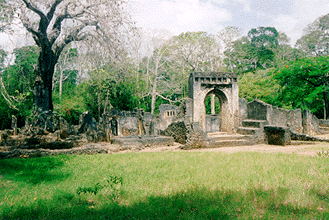
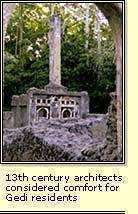
"Gede villages on the seaward side off the main Malindi Road and a short distance before Watamu houses Kenya’s most important monument, the GEDE or GEDI RUINS about 20 kms south of Malindi town - an Islamic civilization city, which disappeared mysteriously about three hundred years ago. The ruins were gazetted as a monument in 1927 and became a National Park now a National Museum (45 acres) in 1948. The great city Mosque and parts of the King’s Palace and other city houses have been restored, well-preserved and signposted with well maintained trails for the benefit and enjoyment of the visitors who can now view them with admirable ease. From Gede village one travels for about 8 kilometres to Watamu village beyond which is the Watamu Marine National Park established in 1968 for the preservation of the coral reef resources." Source: The National Museum of Kenya GedeGede is a coastal town founded in the 13th century, the ruins from which are now an important historical site in Kenya. Built on a coral spur, its outer wall encompassed 45 acres. The opulent town proper resided within an inner wall, containing a palace, three pillar tombs, and a great mosque as well as several smaller mosques and private houses. Lying four miles inland and two miles from a navigable creek, Gedi was undoubtedly influenced by Swahili culture but probably did not participate directly in the trade that linked towns along the Swahili Coast. Gedi was never mentioned by the Portuguese, who occupied nearby Malindi from 1512 to 1593, nor in any other written record from around the time it was inhabited. Yet the ruins of Gedi show clear evidence of a highly developed and wealthy African civilization. Archaeological excavations have determined that Gedi was founded in the 3th century and was probably rebuilt during the 15th century, the height of its prosperity. Gedi was abandoned in the 16th century, reoccupied for a short time, and then permanently abandoned in the early 17th century. Many of the construction details indicate that builders considered the comfort and well-being of the city's occupants when constructing Gedi.The palace, for example, features sunken courts, the purpose of which was to create a longer shadow and therefore a cooler, more pleasant place to sit. Walls contained pegs for hanging carpets. In private residences, walls were thick and roofs were constructed of stamped red earth, also to create a cool living environment. All of the private residences and the palace included partitioned lavatories with washing bowls and bidets, as well as strong rooms off the owner's bedroom for storing valuables. These rooms contained no doorways; instead, one entered via a trapdoor reached by climbing a ladder. Sumps were located throughout the town to hold surface water that would otherwise have compromised the walls of structures. A few hundred meters from the palace stood the great mosque, which was built around the middle of the 15th century. Constructed of stone, the roof was covered with coral tiles laid in lime concrete. A broad-bladed spear, a traditional Swahili symbol of kingship, was carved into its entranceway. Located at intervals around the inside walls were square niches in which lamps were placed for night prayers.
Source: Microsoft Encarta Africana. We appeal for your donation for our charity
Copyright© March 2003: The Waswahili Community Trust (UK) Back
| |||||